AI Trading Journal: What It Actually Does (2026)
AI trading journals sync trades, tag setups and answer questions about your history. Here is what the technology does, where it falls short, and how to compare the options.
Daniël Vermes
Tradeflow Editorial Team
Why journals needed automating in the first place
Manual journaling has a failure rate that would be unacceptable in any other tool. Most traders who start one have stopped within three months.
The reason is arithmetic rather than character. Logging a trade by hand takes a few minutes. Doing it fifteen times a day means over an hour of daily clerical work, and it will not survive the first genuinely busy week. Worse, almost all of that effort goes into copying numbers your broker already recorded: entry, exit, size, time, fees, result. Transcription produces no insight at any volume.
Then there is the part nobody admits. Logging is not the step that fails. Review is. Ask someone who abandoned a journal how many times they went back and properly analysed what they had logged, and the answer is usually once, in January.
Automation is aimed at both problems, and most platforms only solve the first.
What the different ai journals actually do
Not all AI trading journals work the same way. Tradeflow includes conversational AI that can act on your data — tagging trades, surfacing patterns, answering questions about your full history — available on every plan from $19 a month. TradeZella starts AI features at $35 and uses a mix of scheduled agents and chat. TraderSync gates AI on its Premium tier at $49.95. TradesViz and Edgewonk offer weekly reports or limited chat with no bulk-action capability. Pricing as published by each provider, 2026.
Two things stand out. AI is now table stakes rather than a differentiator, so the useful question is no longer whether a journal has AI but what the AI is permitted to touch. And most platforms treat the journal as the end of the process, where the data lives and dies inside your account.
Read-only ai versus ai that acts
This is the distinction that matters most and it is the one buried in every feature list.
Read-only AI answers questions. Ask which setup performed best last quarter and it tells you. Useful, and it is where most platforms sit. But it cannot change anything, so every insight it produces becomes a task you now have to do by hand.
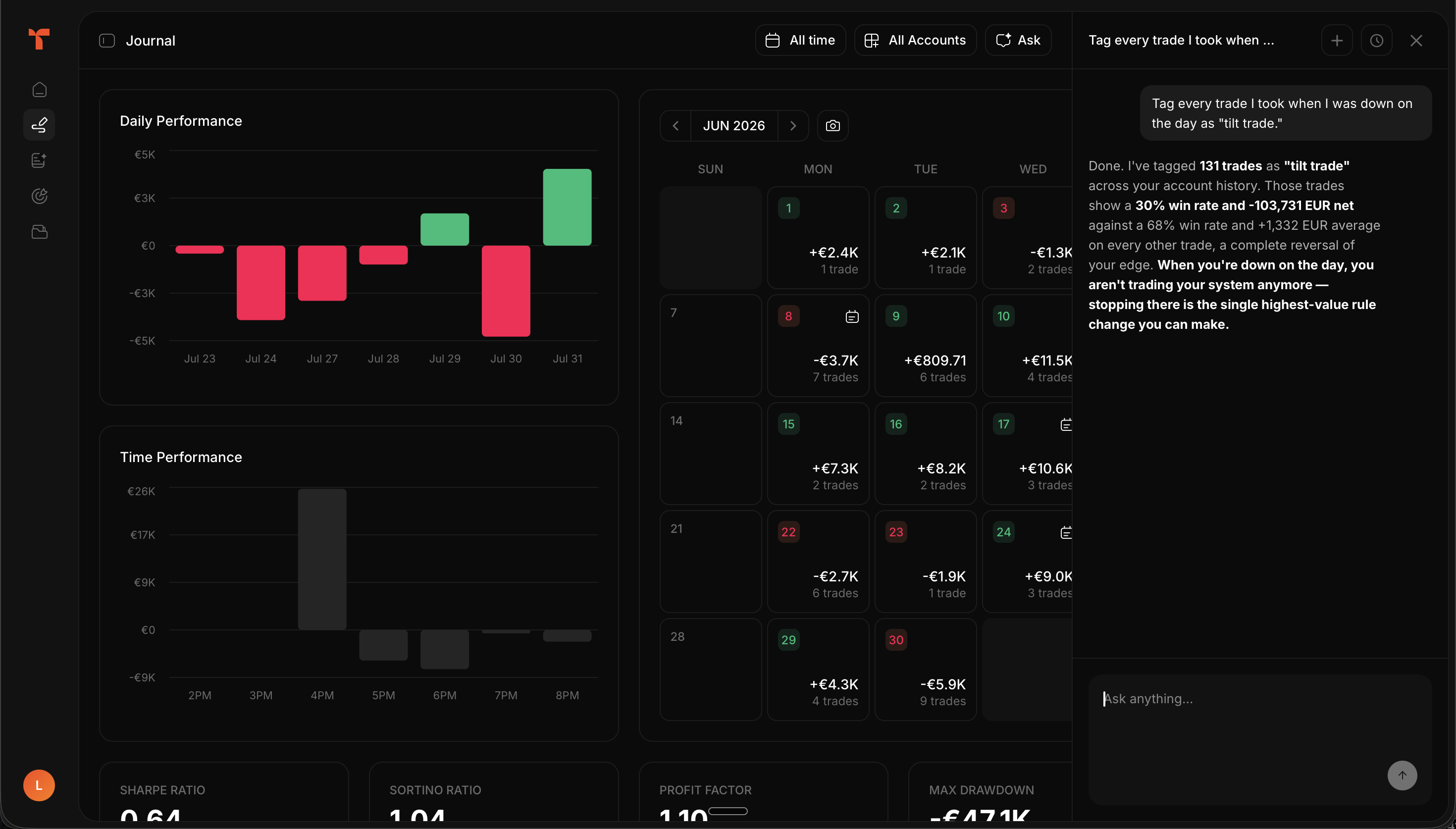
AI that acts changes your data. Ask it to tag your last five losing trades as tilt and those trades are tagged. Ask it to find where your discipline breaks down and it analyses the history, surfaces the cluster and labels it.
The difference sounds incremental until you consider the review workflow. Read-only AI tells you that trades taken within an hour of a loss underperform. You now have to go and identify every one of those trades and tag them, which is exactly the tedious work you were trying to avoid, so you postpone it and the insight evaporates.
AI that acts closes the loop in a sentence. That is the whole difference between a review that happens and a review that gets scheduled for next Sunday indefinitely.
Configured agents versus conversation
Among platforms whose AI can act, there is a second split worth understanding before you choose.
Configured agents run on rules you define in advance. You tell the system to tag anything held under five minutes with a drawdown as a late entry, and from then on it applies that rule automatically at close. Powerful and genuinely hands off, with one structural limitation: it can only tag what you thought to configure. The pattern you have not noticed yet is not in your rules, so it never gets tagged.
Conversational AI works the other way. Nothing is configured up front. You notice something on a Sunday evening, ask about it, and get an answer plus the tagging applied to your history. It handles the question you did not anticipate, which is where most real insight lives.
Neither is strictly better. Configured agents win on unattended consistency. Conversation wins on discovery and requires no setup at all, which matters more than it sounds given how many traders never complete a configuration flow.
Tradeflow is built on the conversational model. You connect a broker and start asking. There is no rules engine to populate before the product becomes useful.
What ai genuinely finds that you will not
The honest case for AI here has nothing to do with intelligence. It is that human review is structurally bad at three specific things.
Sample size. Your edge becomes visible somewhere around 50 to 100 trades per category. You can hold roughly the last ten in your head. Everything before that blurs, so you end up reasoning from a memorable sample rather than a representative one.
Confirmation bias. Reviewing your own trades, you unconsciously look for evidence supporting what you already believe. If you think your mornings are strong you will notice the morning winners and skim the morning losses. This happens to disciplined people who know it happens.
Multi-variable blindness. Your edge may exist only at the intersection of setup, session and state. With five setups, three sessions and four states that is sixty combinations to check. Nobody does that by hand, so the interaction effects stay invisible.
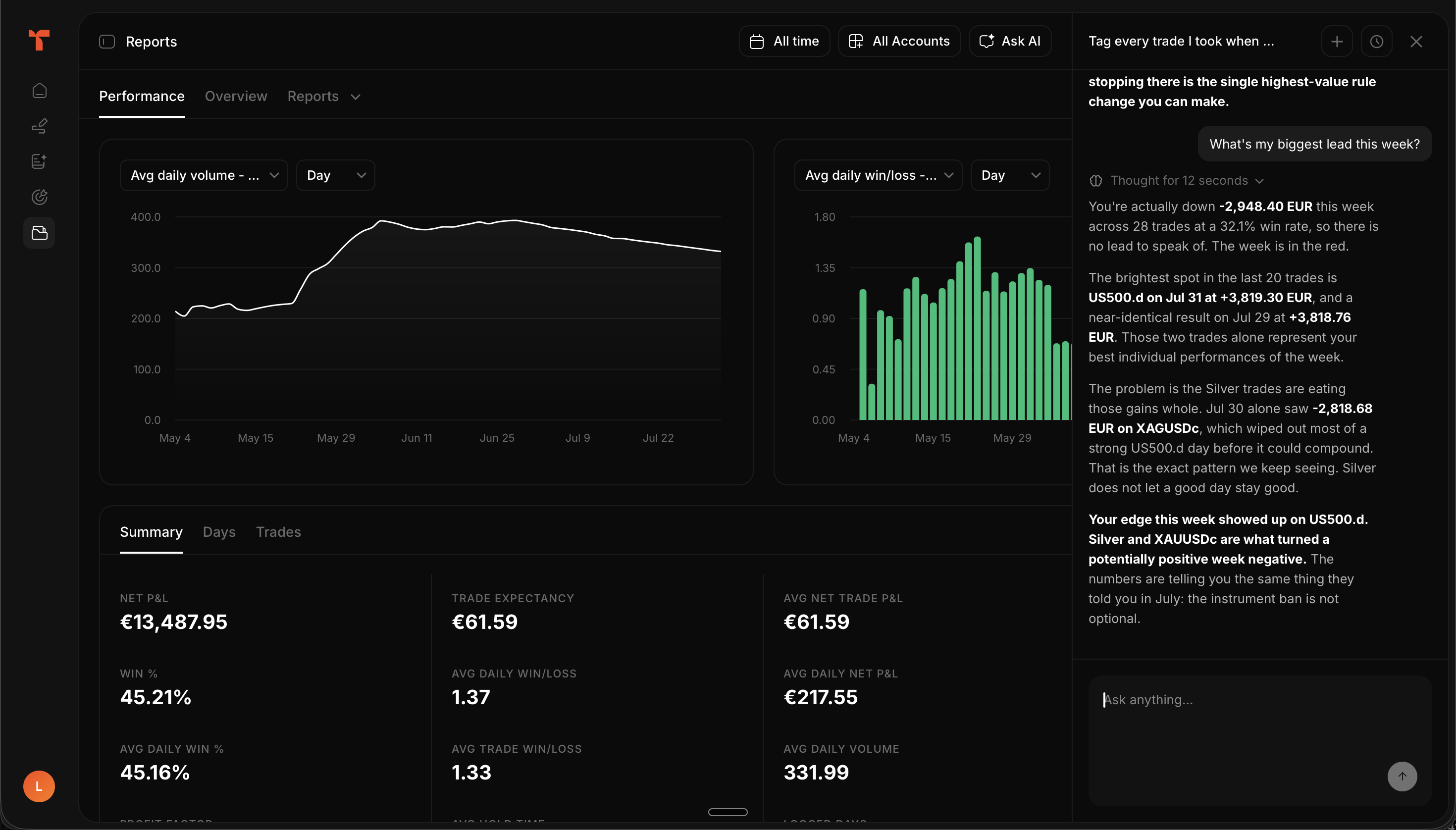
The patterns that fall out of fixing those three are consistent across traders. Position size creeping upward after two winners. Losses clustering in a specific hour. One setup carrying the entire account while four others quietly break even. A profitable strategy slowly drifting from its original entry criteria over months, unnoticed because the drift was gradual.
None of these are visible in any single trade. All of them are obvious across two hundred.
What ai still cannot do
Worth being direct about, since the category is prone to overclaiming.
AI cannot know why you entered. It sees a trade at a price at a time. It does not know you hesitated, or that you took it because you had not traded yet that day and were getting restless. It can identify a cluster of losses that look behaviourally driven. It cannot tell you what you were feeling, only that something happened worth examining.
That gap is where the remaining manual work lives, and it is about twenty seconds per trade. One line on why you entered and how you felt. Every genuine insight a journal has ever produced came from connecting that context to the data, and no amount of automation removes the need for it.
Which is the actual division of labour. Your broker supplies the facts, the AI does the labour, you supply the judgment.
Why this matters beyond your own review
There is a second use for tagged, verified trade data that most journals ignore entirely.
A journal keeps your analysis private. That is appropriate for the reviewing part, but it means the work stops there. When the same verified data can become a public track record, your tagged history turns into evidence: a prop firm can see which setups you are actually profitable on rather than a P&L line, and an investor can audit the edge by category.
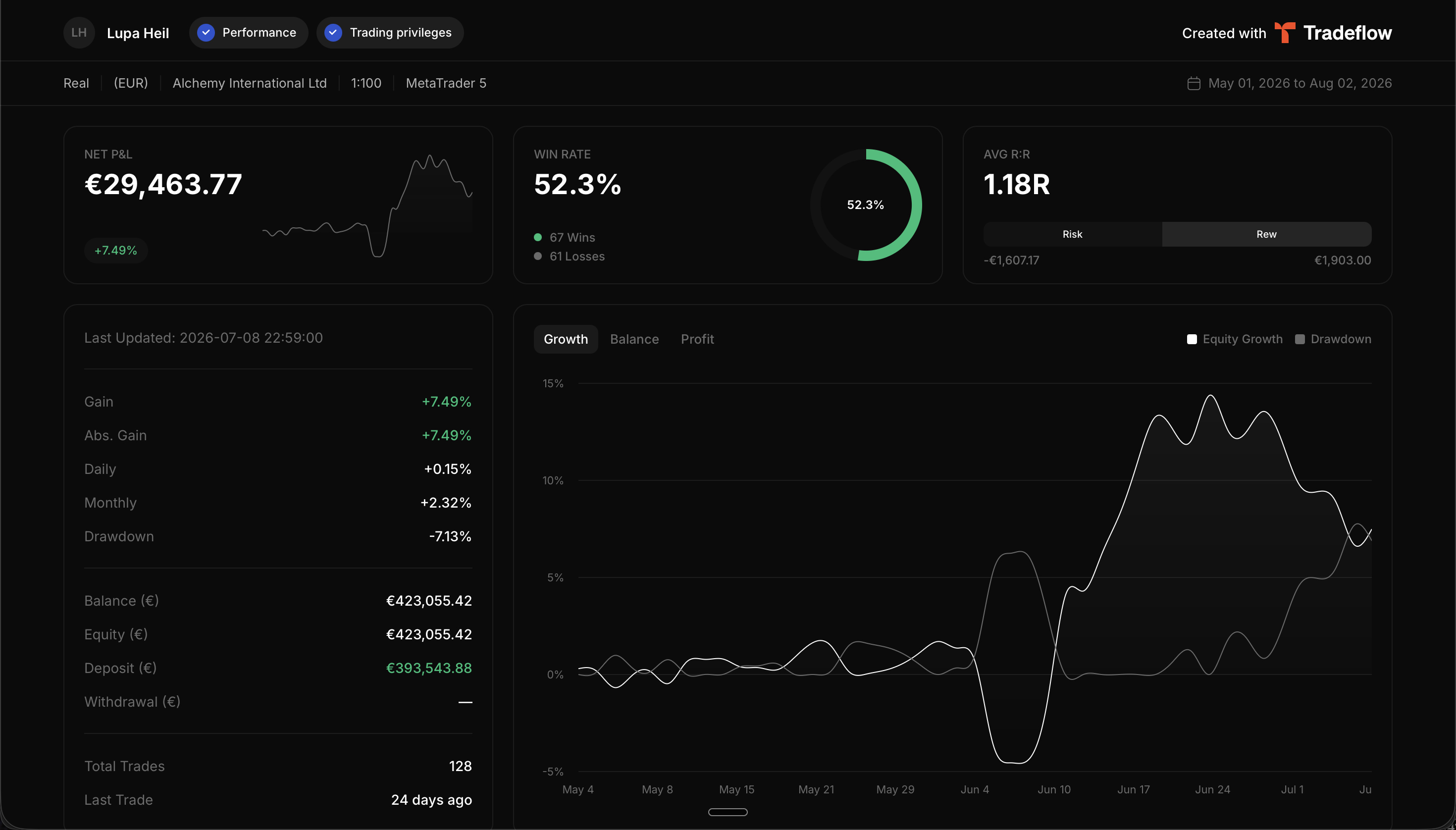
This is the part of the category that has barely been touched. Every platform competes on how well it analyses your private trades. Almost none give you anything to do with the result. Tradeflow builds a verified track record from the same broker connection, shareable as a live link or as a snapshot frozen to a date you choose, which is what an application actually needs.
How to evaluate an ai trading journal
Five questions, in order of how much they matter.
Does it sync your broker, and completely? If any part of your workflow involves exporting a CSV, the data will be stale and incomplete within a month. Check your specific broker rather than the headline number.
Can the AI change your data or only describe it? Read-only AI turns every insight into homework. Ask specifically whether it can tag, not just whether it can answer.
Is the AI on the plan you will actually buy? Several platforms put AI behind a top tier at two to four times the entry price, which puts the most useful part of the product furthest from the traders most likely to quit. Tradeflow includes it on all three plans starting at $19.
How much setup before it is useful? Configuration flows have high abandonment. If the product needs an hour of rule building before it does anything, factor in the probability that you never finish.
What happens to the data afterwards? Analysis that stays locked in a dashboard has one use. Data that can also become verifiable proof has several.
Key takeaways
An AI trading journal syncs trades automatically and uses AI to categorise them and answer questions about your history. The meaningful split is not whether a platform has AI but whether that AI can act on your data or only describe it. Read-only AI converts every insight into manual work, which is why the review step still gets skipped. Configured agents run unattended but only catch patterns you anticipated — conversational AI catches the ones you did not. AI fixes sample size blindness, confirmation bias and multi-variable blindness, which are the three reasons manual review fails. It cannot know why you entered or how you felt, and that twenty seconds per trade is still yours. Tradeflow includes conversational AI on every plan from $19, syncs 600+ brokers, and turns the same data into a verified track record.
Frequently asked questions
What is an AI trading journal? A trade logging platform that imports trades automatically from your broker and uses artificial intelligence to categorise them and answer questions about your history. The more capable versions can also act on your data, applying tags across your history from a plain English request rather than only describing what they find.
How is it different from a regular trading journal? A regular journal requires manual entry and manual tagging, then leaves the analysis to you. An AI journal removes the transcription and, in the better implementations, the filtering and tagging work that makes review too slow to happen weekly.
Can I just use ChatGPT for this? Not really, for one structural reason: it has no connection to your broker. Every conversation starts by pasting a trade log and re-explaining your strategy, and nothing persists. It is useful for thinking through concepts. It cannot tag two hundred trades in your history because it does not have them.
Does AI tag trades correctly? It depends on what is being tagged. Anything observable in the data, such as session, hold time, R multiple or sizing, is reliable. Anything about your intent or emotional state is inference from behaviour, so treat those as candidates to confirm rather than facts. Reviewing the suggestion is where the learning happens anyway.
Do I still need to journal manually? For the mechanical fields, no. For why you entered and how you felt, yes, and that is about twenty seconds per trade. Those two fields are where nearly every useful insight comes from.
How many trades before it tells me anything? Roughly 30 in a single category for a basic conclusion, and 50 or more when you are looking at combinations of setup, session and state. Below that you are reading noise.
Is an AI trading journal worth it over a spreadsheet? A spreadsheet is free and costs you 15 to 30 minutes per session, which is why most are abandoned inside 90 days. The value is not the software, it is that review actually happens when it does not require an afternoon. Entry plans in this category run from $19 to $35 a month.
Which brokers are supported? Varies significantly by platform. Tradeflow supports 600+ including MT4, MT5, cTrader, DXtrade, TradeLocker, Tradovate and Interactive Brokers. Check your specific broker before committing anywhere.
Start with a journal that keeps itself
Tradeflow syncs every trade automatically from 600+ brokers and platforms, includes conversational AI on every plan, and turns the same verified data into a track record you can actually show someone.
Start free for 7 days. From $19 a month afterwards.
Got questions?
We've got answers. If you don't see what you're looking for, reach out to our team.
Get startedWhich brokers are supported?
Is there a free trial available?
How does Tradeflow work?
Can I cancel my subscription anytime?
Is my trading data secure?
This is where everyday traders become champions
Ask AI about Tradeflow


© 2026 Tradeflow. All rights reserved.